
The government has also given permission to 20 plants to produce the antiviral drug.

For decades, multinational pharmaceutical companies and Indian drugmakers worked in ways that supported each other: MNCs brought innovation and brands, while Indian companies built scale through generics and cost efficiency. There was an important overlap - generic drugs - but this is shrinking fast. And the consequences are reshaping India's gigantic pharmaceutical market.

Concerns over weakening demand for Indian pharmaceutical (pharma) drugs in the US - their largest export market - have weighed heavily on investor sentiment this year. While the Nifty 50 has gained 6.02 per cent year - to - date (as on September 15), the Nifty Pharma index has declined 5.18 per cent, National Stock Exchange data shows.


Prices for Indian consumers are expected to come down significantly from the current Rs 17,000-Rs 26,000 monthly.
They seek to profit from big-selling drugs going off-patent this year in the lucrative market.

The US Food and Drug Administration's (USFDA)'s new draft guidelines aimed at speeding up and reducing the cost of developing biosimilars - lower-priced, near-replicas of complex biologic medicines - could significantly benefit Indian biotech companies.

Enhertu currently costs around Rs 1.6 lakh per 100-milligram injection.
Yusuf Hamied, Anji Reddy and Parvinder Singh are the real pioneers of the Indian pharmaceutical industry.

'Our problem is not a budget deficit but a trust deficit. We need to trust our institutions and industries to innovate and lead. That is the way forward for India.'
Regulator says fee would enable it to quicken approval process.
Simvastatin goes off patent in late June; Ranbaxy gets 180-day exclusivity period; Dr Reddy's-Merck will be third player.

India is home to more than 100 million diabetics, and the demand for anti-diabetic drugs is on the rise -- the Rs 20,611 crore anti-diabetic drug market in India is growing at 9 per cent or so.
Pharmaceutical major Matrix Laboratories, public sector oil producer Oil and Natural Gas Corporation and Ranbaxy Laboratories have emerged as the fastest, biggest and the most consistent wealth creators for year 2006
Stringent regulatory norms and the financial impact of the global credit crisis on some research companies may hurt half a dozen molecules of Indian companies, such as Glenmark, Nicholas Piramal and Ranbaxy Laboratories, that are close to launch, experts and analysts said.

This move could cost $299 million a year for Indian pharma players.

The upside for Ranbaxy Laboratories is likely to continue even as it loses its 180 days of marketing exclusivity for the Lipitor generic in the American market.
Two years after India entered the product patents regime, the year 2007 saw Indian drug firms striving to shed the copycat image and become innovators with emphasis on research activities even as they resisted moves to include more medicines under price control.

Dr Reddy, an innovative technocrat par excellence, led from the front the countless initiatives of his famed laboratory in discovering many effective, affordable, cures for the numerous ailments of mankind, writes Shreekant Sambrani.

Major Indian drug companies such as Ranbaxy Laboratories, Lupin, Dr Reddy's Laboratories and Glenmark have gone off the beaten track in overseas markets.
Leading Indian drug majors, such as Ranbaxy Laboratories, Dr Reddy's Laboratories, Piramal Healthcare and Wockhardt, are in-licensing popular products from overseas drug makers to boost their domestic sales.
According to analysts, Indian drug makers are forging alliances with overseas companies such as CD Pharma, Gnosis SpA, Crawford Healthcare and Syrio Pharma to sell drugs for chronic and acute cases. According to analysts, Indian drug makers are forging alliances with overseas companies such as CD Pharma, Gnosis SpA, Crawford Healthcare and Syrio Pharma to sell drugs for chronic and acute cases.
Ranbaxy Laboratories, Dr Reddy's Laboratories and Sun Pharma's US subsidiary Caraco Pharmaceuticals are among the 13 generic manufacturers to get first generic approvals from the US Food and Drug Administration to manufacture and market generic versi

Equity benchmark indices halted their three-day gain on Tuesday, with the Sensex falling over 317 points in early trade, amid weak global market trends and persistent foreign fund outflows. Firm crude oil prices in the international market also put pressure on equities. The 30-share BSE Sensex was trading 317.41 points lower at 52,843.87. The NSE Nifty dipped 99.65 points to 15,732.40.

Companies say they follow global standards in India as well
Sales growth of generics drugs has dropped to 3.6 per cent in the 12 months ended September 2008 compared with 11.4 per cent growth a year earlier, according to the latest report of IMS Health, the leading provider of market intelligence to the global pharmaceutical and healthcare industries. However, sales by volume increased by 5.4 per cent in the US, reflecting declining prices and fewer blockbusters losing patent protection in 2008.
India and China together account for 32 of the 50 companies in Forbes' sixth annual 'Asia's Fabulous 50 listed companies'.
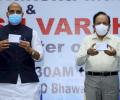
Commercial launch and supply to major government and private hospitals is expected in mid-June.
Domestic pharma giant Ranbaxy Laboratories Limited has topped the list of patent filers in the area of drug applications from the Third World countries last year with 64 new formulations.\n\n\n\n

Companies such as Dr Reddy's Laboratories, Sun Pharmaceutical, Lupin and Ranbaxy striving to capitalise on opportunities created by pro-generic health care reforms in the US market are facing pricing pressure as the health care supply chain is undergoing consolidation.
The ability of Indian pharmaceutical companies to command higher margins in international markets is helping sustain business.

The teams were from Gennova Biopharmaceuticals Ltd Pune, Biological E Ltd Hyderabad and Dr Reddys Laboratories Ltd Hyderabad.

After getting periodic extensions, the 14-year-old tax-refund scheme is finally coming to an end in June.

India emerging as a big global destination for contract manufacturing, unlike R&D outsourcing.
